
The Piano Girl
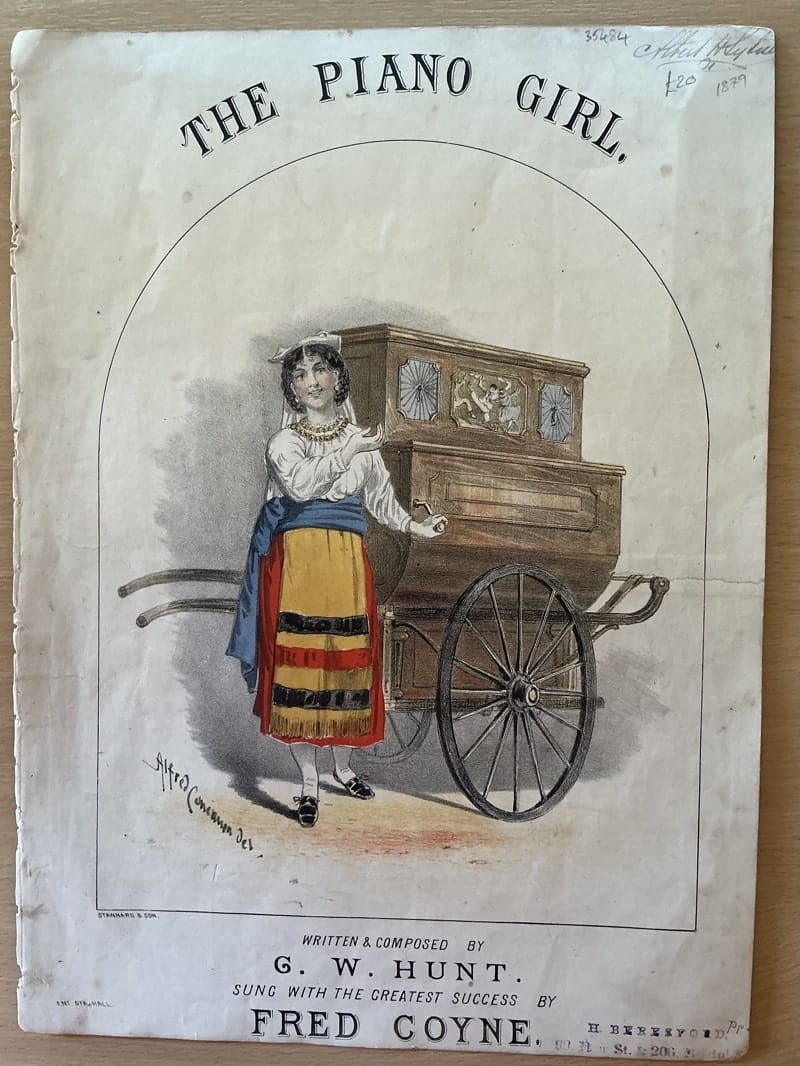
Another post on a single item of ephemera, this time bought at the Society’s Ephemera Fair in May 2026.
I am not a collector, but every so often an item appeals to me. In this case, although I was familiar with images of organ grinders and fair organs, and with later player pianos, the idea that cumbersome barrel pianos (often called street pianos) were wheeled around London streets was new to me.
As is so often the case with ephemera, the item sparked questions and necessitated enjoyable and fruitful armchair research.
Although, properly, the presence of the score puts this example into the domain of music rather than ephemera, the lyrics proved invaluable in contextualising the rather exotic ‘piano girl’ in the image. In the song, the ‘piano girl’ is courted by a gentleman, who discovers at the altar that her colouring is false and that, far from being Italian, she really hails from Cork. Indeed, the centre of production of street pianos in London was Little Italy and the itinerant musicians (who merely operated the crank) were mostly Italian.
Unlike pianolas and modern player pianos that use paper rolls and foot pedals, these were heavy, cart-mounted street instruments. Turning the hand-crank rotated a wooden barrel pinned with metal staples that tripped spring-loaded hammers to strike piano strings. They played popular songs of the day and made a loud sound. At this stage, such pianos lacked the subtleties of touch characteristic of ‘real’ pianos. The fidelity of the illustration is validated by the example of a street piano, complete with barrow, exhibited at the London Museum: https://www.londonmuseum.org.uk/collections/v/object-494041/barrel-piano-street-piano/.
Sheet music with illustrated covers is not rare. The Piano Girl, for example, is held by the British Library, the Bodleian Library and the V&A: (https://collections.vam.ac.uk/item/O1272408/the-piano-girl-sheet-music-alfred-concanen/).
Sheet-music covers (sometimes called music title-pages or music titles) merit an eight-column entry by Michael Twyman in The Encyclopedia of Ephemera. He states that ‘Apart from the pictorial poster, which developed somewhat later, no other category of ephemera provided artists with quite such a wide range of opportunities in terms of subject matter’ (p. 291).
The covers became a collecting genre in their own right. At their best, even allowing for artistic licence, they are important documents of social history, from surprisingly early (the 1840s) to the early 20th century. They illustrate many aspects of life, including fashion, street life, trade, transport and events such as the Great Exhibition of 1851 and the International Exhibition of 1862. There are songs, dances (such as lancers, quadrilles and polkas) and piano solos, usually with more conventional imagery, such as landscapes.
Sheet-music covers for popular songs are important in documenting performance history, especially in music halls. Tellingly, images of performers on music covers are recognised as valid portraits by both the National Portrait Gallery (John Hall Collection): https://www.npg.org.uk/collections/search/set/509/John+Hall+sheet+music+covers
and the V&A Performance Collections.
In England, the genre was blessed with exceptional, specialised lithographers, notable among them John Brandard, William Brandard, A. Laby, H.C. Maguire and T. Packer. The prolific lithographer of our example, Alfred Concanen (1835–86), was described as the most innovative by Michael Twyman in his entry in The Encyclopedia of Ephemera.
The Piano Girl is quintessentially representative of the genre. Its composer (George William Hunt, c. 1837–1904), singer (Fred Coyne) and publisher (Hopwood & Crew) all specialised in music hall songs. This particular copy was bought from H. Beresford, a prominent late 19th century sheet-music publisher and seller of music and musical instruments, in Birmingham (99 New Street and 206 Bristol Street) and London.
Fred Coyne (1847–84) was a relatively minor music hall singer. Opinions of his talents vary, but many songs that he performed survive, illustrated with portraits of him in character.
There is no printed date, but the manuscript date at top right (1879) is corroborated by the V&A catalogue entry. In the V&A copy, the imprint of Hopwood & Crew and the price are visible on the cover. Mine has been cropped, with loss of the imprint and also part of the price, of the music seller’s stamp and of the owner’s name. Sheet music was frequently cropped to achieve a uniform size for binding into an album. The left margin has damage consistent with this, and the cover has become detached. To some collectors and institutions, imperfections detract from the item; to others they enhance it.
Though I bought this on a whim, researching it has led me into some unexpected corners of history which, to me, is one of the great joys of ephemera.
Digitised collections of sheet-music covers
Bodleian Library. A large sample from the Harding Collection formed the basis of a crowd-sourcing project: http://digital.bodleian.ox.ac.uk/collections/whats-the-score/. Music titles in the John Johnson Collection are online through ProQuest: https://www.proquest.com/johnjohnson?accountid=142537 (under Entertainment).
University of Reading Library. The sheet-music covers in the Spellman Collection are online through VADS (Visual Arts Data Service): https://vads.ac.uk/digital/collection/SCVMC/search
Ward Irish Music Archives, Milwaukee, Wisconsin: https://irishsheetmusicarchives.com/Galleries/Alfred-Concanen.htm