
The Ephemera of the Twelfth Cake
For centuries, the twelfth cake was a central part of English secular celebrations of Epiphany. Twelfth cakes and the festivities surrounding them are amply documented: in diaries (including those of Samuel Pepys and Queen Victoria), books, journals, newspapers and in literature.[1] They are also intrinsically linked to a surprisingly diverse range of ephemera.
Originally leavened, the twelfth cake became essentially a dense, rich fruit cake. Traditionally, the male guest who found the dried bean concealed in one half of the cake became ‘king’ (as in the French galette des rois). His queen was the lady who discovered the dried pea in the other. This, however, evolved into something more elaborate and led to the development of a new form of ephemera: Twelfth Night Characters.[2]
Samuel Pepys records the innovation in his diary of 6 January 1668/9:
‘…and in the evening I did bring out my cake — a noble cake, and there cut it into pieces, with wine and good drink: and after a new fashion, to prevent spoiling the cake, did put so many titles into a hat, and so drew cuts; and I was the Queene…..’
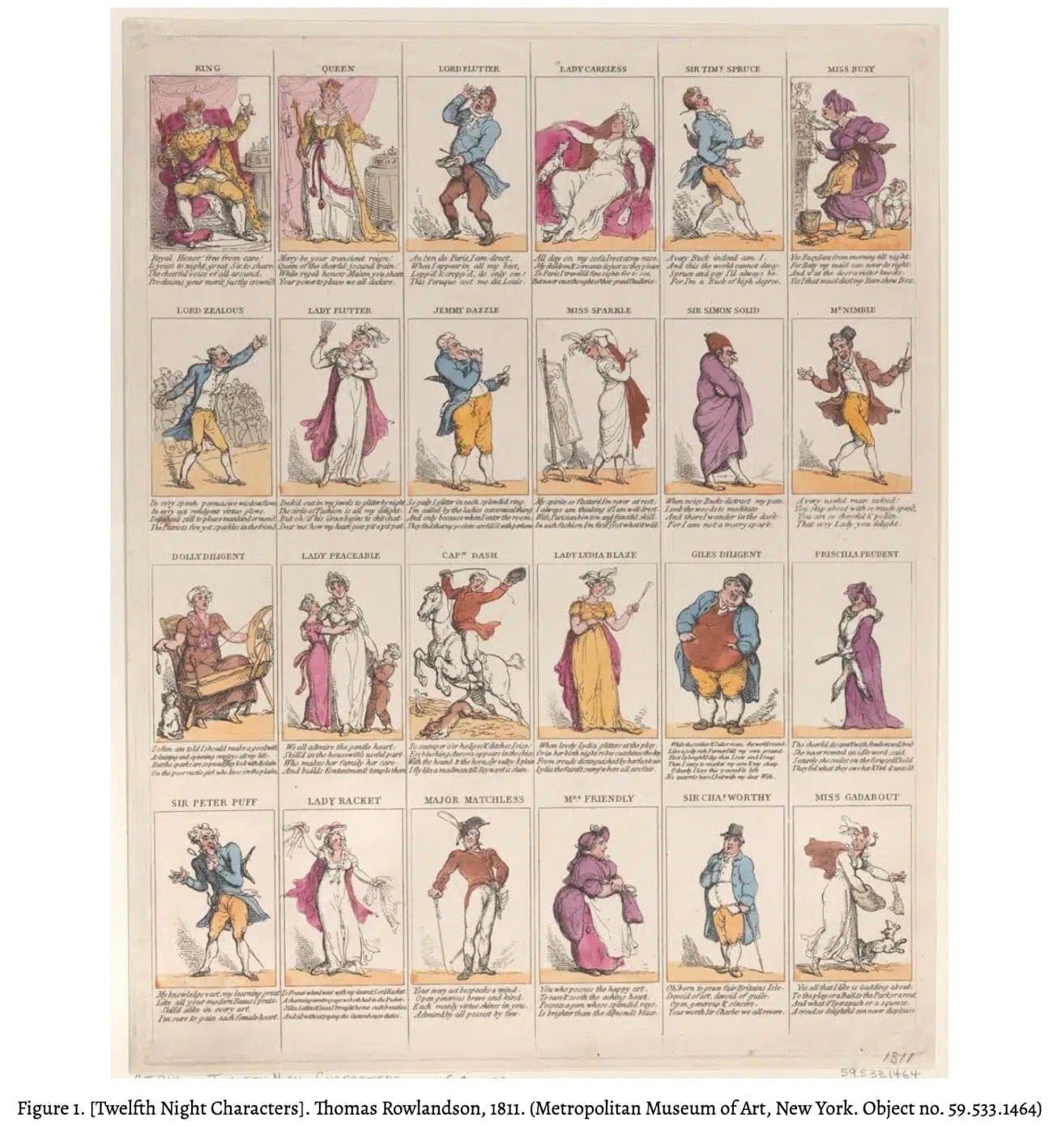
Initially manuscript, it seems that it was not until the end of the 18th century that Twelfth Night ‘characters’ began to be produced commercially, by such as John Wallis and John Fairburn. They evolved into two forms: cards and large sheets (designed to be cut up), both folded before being drawn from a hat (men) or a reticule (ladies). They enjoyed considerable popularity. Although quintessentially ephemeral, a range of 19th century sheets and cards survive, produced by publishers of popular prints, such as Fairburn, A. Park, J.L. Marks, Langley and Ryle & Paul. Some were illustrated by artists of the status of Isaac and Robert Cruikshank and even Rowlandson (Figure 1, above). Variety and novelty were of the essence: characters were inspired by contemporary events and politics, the royal family, popular plays, tradesmen, or more fanciful stock humorous caricatures, such as Gregory Fat, Lady Lovebook or Kitty Captivate. By the 1840s riddles and their solutions also formed part of the sheets or their wrappers. Guests were required to stay in role for the entire evening.
The centrepiece was the cake, and characters are rich sources of illustrations of twelfth cakes. In this 1840 example from the Wellcome Collection (printed by Ryle & Paul), the twelfth cake is depicted not only in the image at top centre but also (as is sometimes the case) within the images for the characters of king and queen. This sheet, for which Wellcome Collection holds two differently coloured versions[3], is also rich in (43) riddles.
[1] An excellent account is given in Cakes and characters: an English Christmas tradition by Bridget Ann Henisch. London, Prospect Books, 1984
[2] See a fascinating discussion of these by Amoret Tanner in The Ephemerist 186, Autumn 2019

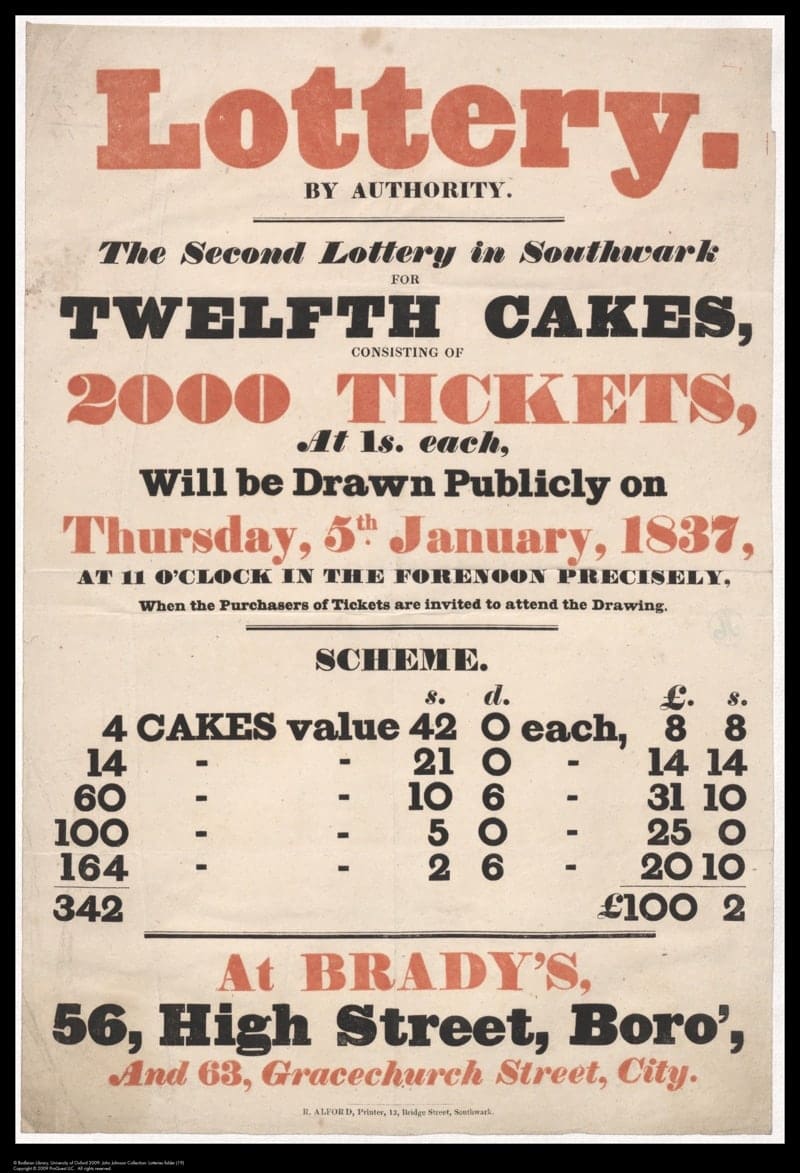
Other sources of characters were lottery agents, who produced them (possibly for sale) in part to advertise ‘New Year’ lotteries. Despite their name, these were not drawn until 12 January or later.
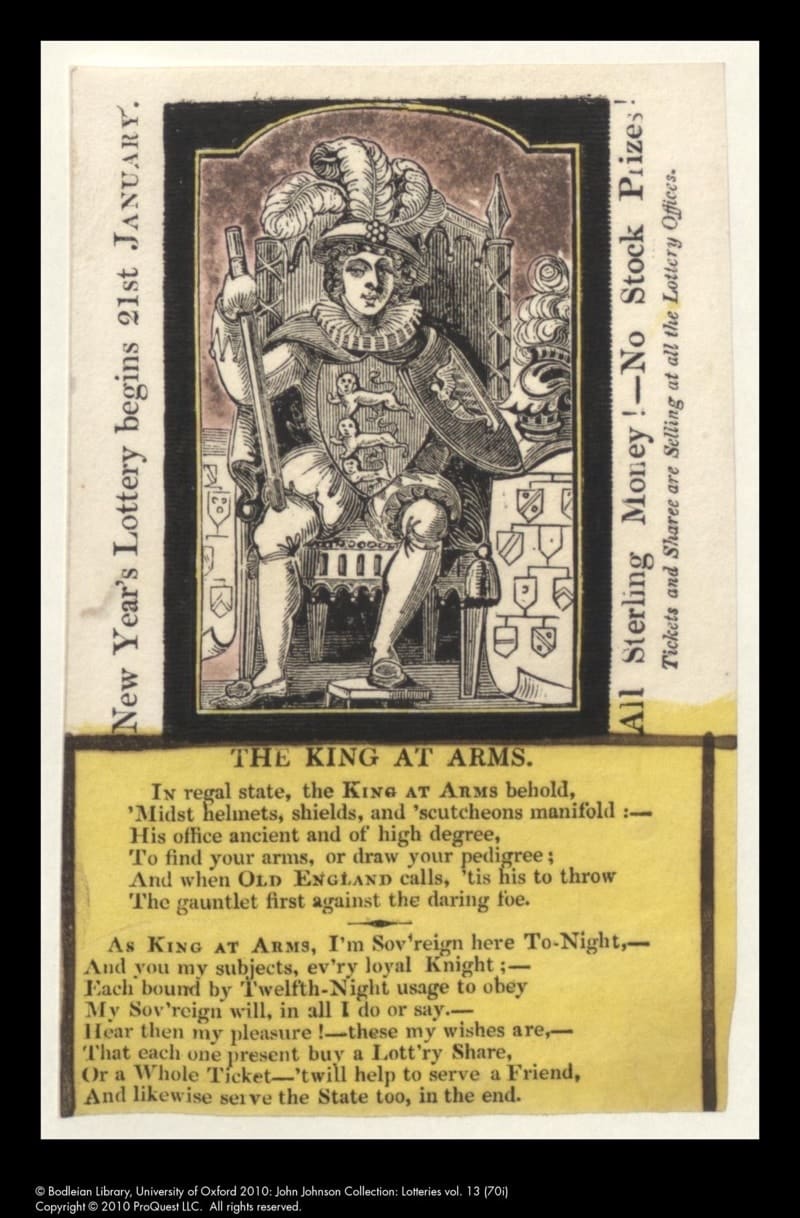
There are also (rarer) surviving wrappers, unambiguously characterised by blank paper surrounding a relatively small central image, sometimes with tell-tale folds, which give us an indication of the size of the cards.
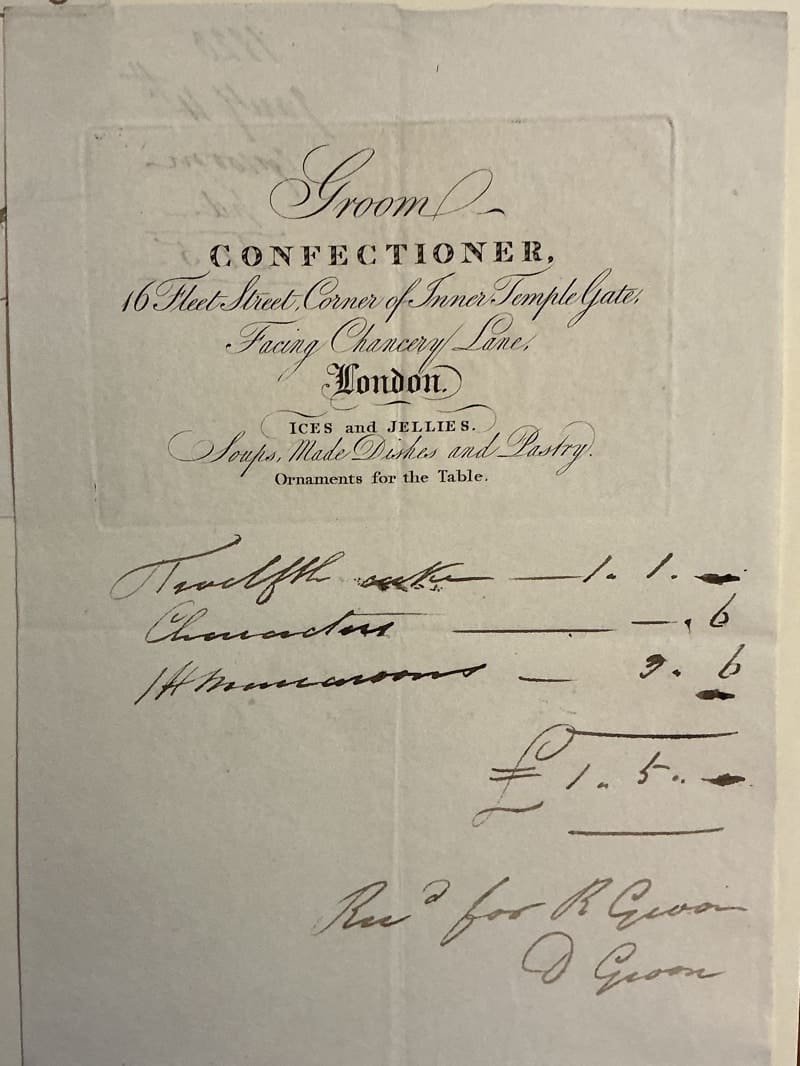
Packets of characters were sold alongside cakes by confectioners. Although twelfth cakes were too seasonal to feature in printed lists of products on trade cards and bill headings, they are recorded in manuscript lists of purchases on used bills. Two of seven examples in the John Johnson Collection (both for Groom, confectioner and dated 1819 and 1820) pleasingly provide evidence of this practice.
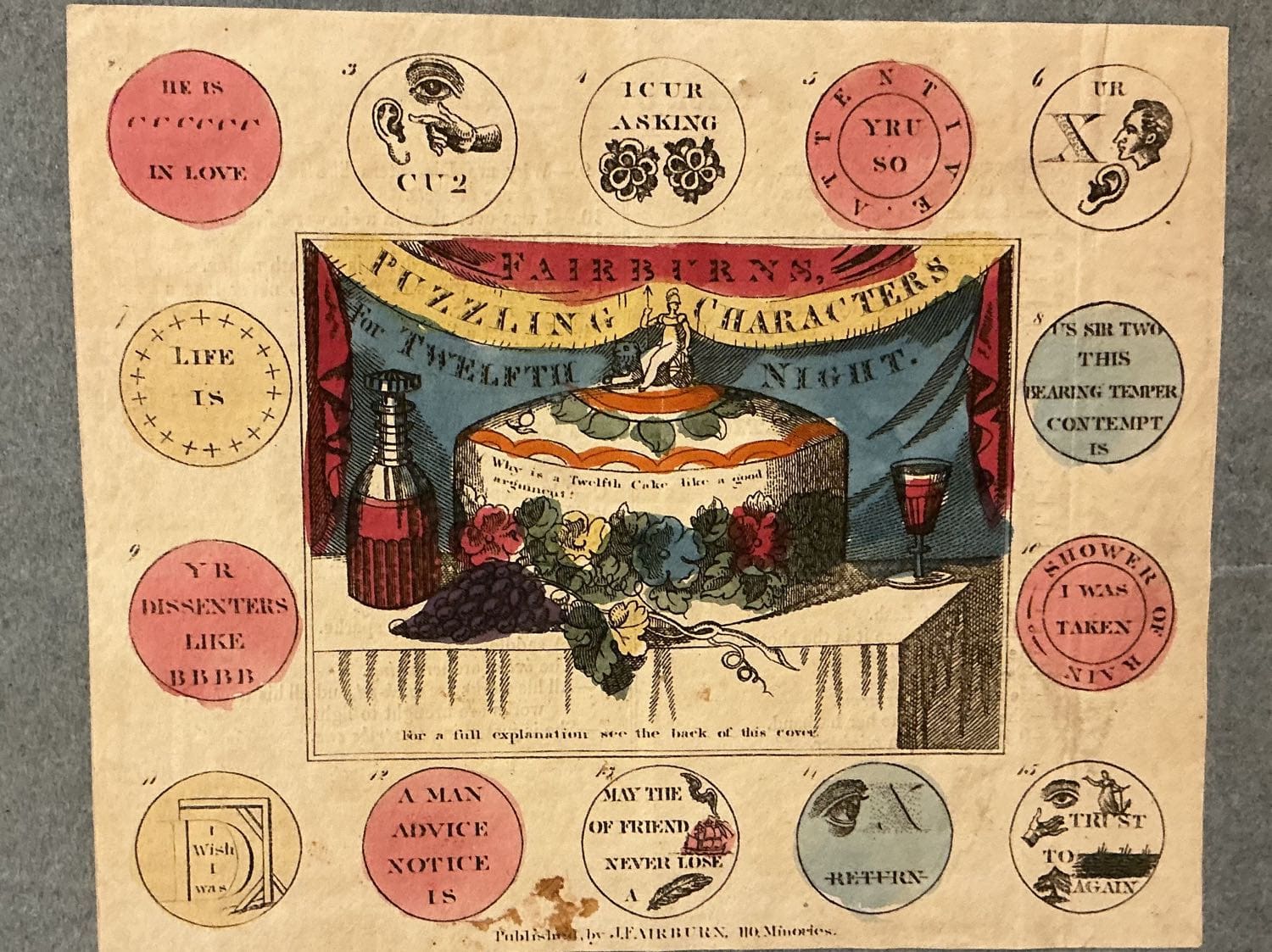
There is a further category of print that intrigues me. The John Johnson Collection includes two attractive sheets that appear to be title pages for characters for parties or miniature theatres. They lack the characteristics of wrappers and correspond in size neither to the much larger folio sheets nor to the packets in which characters were sold. Whatever their function, they are excellent sources of depictions of twelfth cakes.
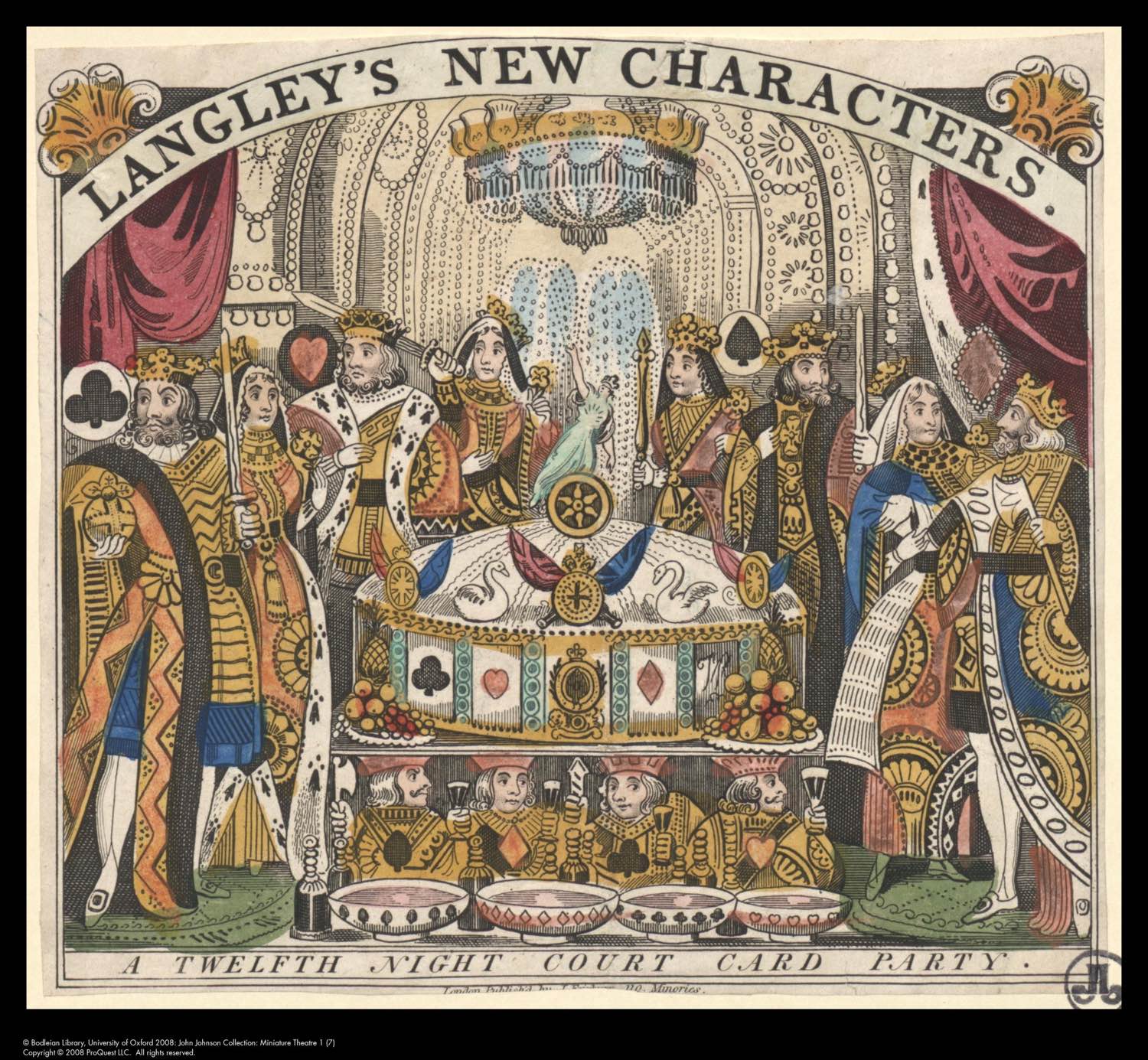
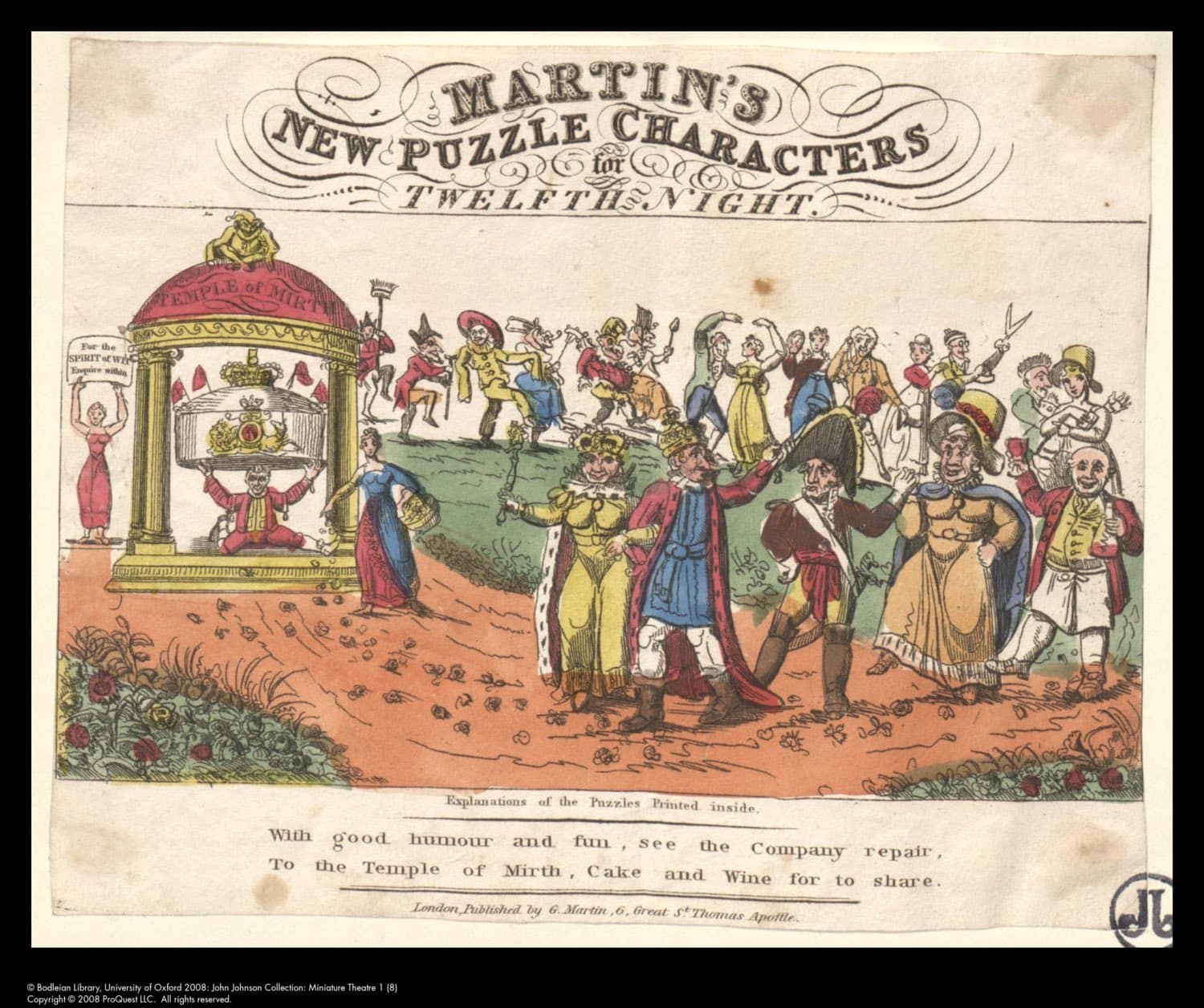
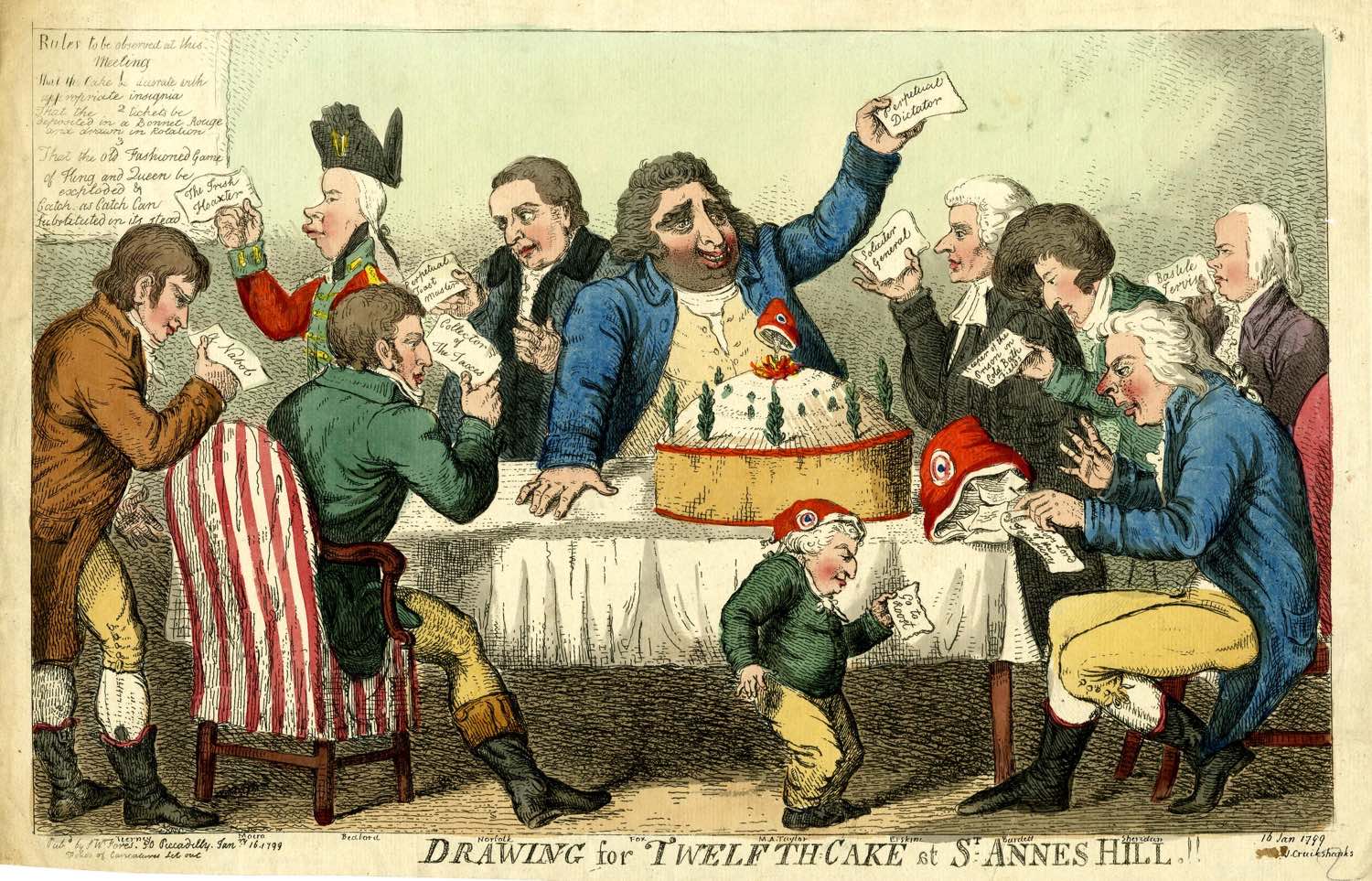
Illustrations of twelfth cakes also feature in several political cartoons, with the ritual dividing up and assignment of characters of a twelfth cake providing a convenient metaphor for political disputes and even for the French Revolution, with papers drawn from a liberty cap (or bonnet rouge) and rules calling for ‘the old fashioned game of King and Queen (to) be exploded & Catch as Catch can substituted in its stead.
Contemporary accounts, such as William Hone’s The Every-Day Book and Table Book, 1826[4], describe and illustrate the popular displays of twelfth cakes in confectioners’ windows on 6 January. Some cakes were huge, as described in this advertising ballad.
[4] https://honearchive.org/etexts/edb/day-pages/006-january06.html#img01twelfthday

Twelfth cakes were sometimes themselves used as prizes in lotteries. The example in Figure 10 claims to be ‘By Authority’. However, in 1860 Louis Dethier’s second twelfth cake lottery was deemed illegal in a crackdown on lotteries. The adverse publicity surrounding the court case led in part to the fall from favour of the twelfth cake.
Another, more serious, charge was the toxicity of the fashionable decorative figurines on top of the cakes, due to the dyes used in their colourings. There were fatalities. As early as 1851, Punch ran a scathing article on poisons present in the painted ornaments adorning twelfth cakes, citing copper, carbonate of copper, zinc, chromate of lead and ‘sulphuret of murcury’ [sic]. A paragraph in The Times of 29 January 1853 headed ‘CAUTION TO PARENTS’ carries a report on an inquest on the death of two brothers from eating painted twelfth cake ornaments containing arsenic. The writer, Professor Taylor, adds, chillingly, that he had come across ten such fatalities in children. Nevertheless, twelfth cakes continued to be enjoyed until the 1880s, when Christmas cakes became more fashionable, and twelfth cake parties died out. Except, that is, at the Drury Lane Theatre, where the tradition is perpetuated thanks to a specific bequest by the pastry chef turned actor, Robert Baddeley[5].
[5] https://spitalfieldslife.com/2024/01/07/at-the-ceremony-of-the-baddeley-cake-i/