
Forms of Death
Remember to Die... And bring this Ticket with you
Dr Dennis Duncan is Associate Professor in English Language and Literature at University College London, and author of a best-selling book: Index, a History of the. Dennis’s next book will be on ephemera. Dennis is a member of The Ephemera Society and, in August, was the first John Sayers Visiting Fellow in Ephemera at the Bodleian Library, researching blank forms in the long eighteenth century. His recent brief presentation on Buried in wool affidavits is online: https://youtu.be/I62ko9d0bJo?si=k3W0chRJE3IbAE7I
This post was first published on Dennis’s Substack blog, Scraps, Orts and Fragments, where other occasional posts on ephemera can be found: https://substack.com/@scrapsandorts/posts
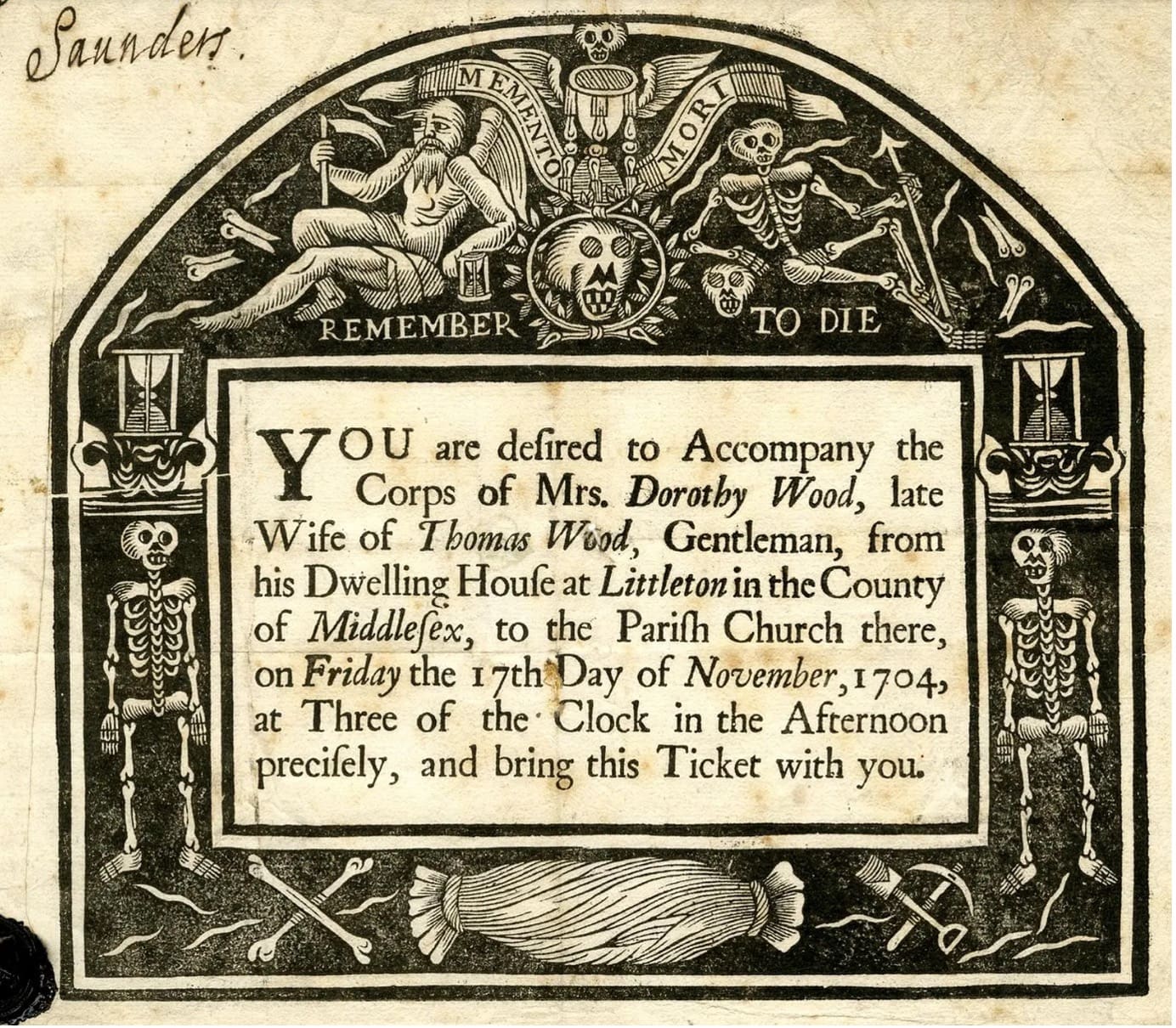
Recently I’ve been spending some time looking at eighteenth-century ‘blanks’ or ‘blank precedents’ – that is, forms where the bulk of the text has been printed but with gaps left for individuals to fill in specific details by hand. Often these are legal documents where it’s important that the form of words used is exactly right. Print, therefore, offers reliability: the person buying the document can have confidence that the technicalities have been taken care of upstream. But the form only acquires its force – becomes an active, binding agreement – when the blanks are filled in by hand. Large-scale bureaucracy, then, is driven by filling in forms. And, up until a decade or so ago, this meant the interaction of print and manuscript.
One type of blank I’ve been particularly interested in is the ‘Burying in Woollen’ affidavit: a slip of paper with an oath printed on it attesting that a recently deceased person was not buried in any material other than wool. Here’s one from Upper Heyford in Oxfordshire in 1712, in which Sarah Bolden swears that the body of Anne Prior was ‘not put in, wrapt, or wound up, or Buried in any Shirt, Shift, Sheet or Shroud, made or mingled with Flax, Hemp, Silk, Hair, Gold or Silver, or other than what is made of Sheeps-Wooll only’.
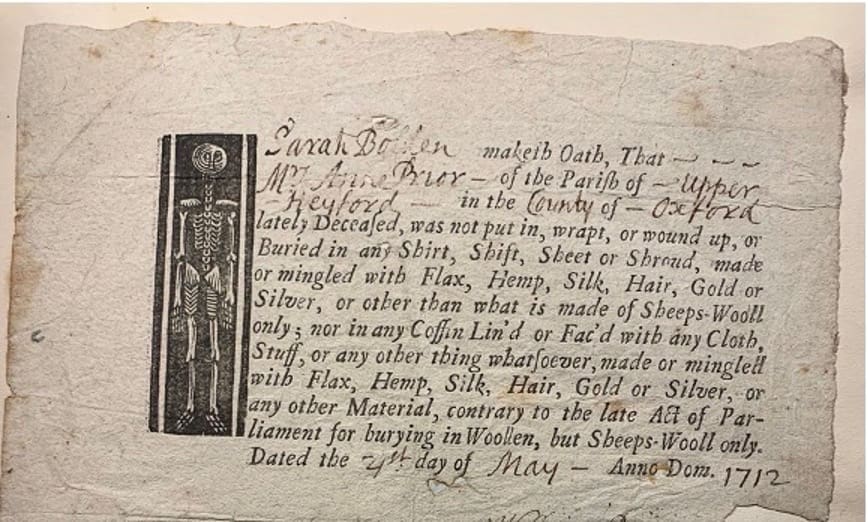
Note the use of a skeleton in a coffin to represent the first word of the oath: ‘I Sarah Bolden…’
Something that struck me about these forms was the fact that the stationer who produced them would sometimes place a little advertisement at the bottom. I don’t think we’re used to seeing advertising on our forms any more. For example:
LONDON, Printed for, and Sold by JOSEPH MARSHALL, at the Bible in Newgate-Street, where are Sold, Bibles and Common-Prayers of all Sorts: Likewise Ink-Powder, by Wholesale and Retale, and Japan-Ink at 6d. a Bottle, and Funeral-Tickets, where Country Chapmen may be supplied; and with Blank Receipts for the Land-Tax, and Window-Lights.
We should note that these forms, that were filled in in rural Oxfordshire, were printed in London. And also that Joseph Marshall’s was a large business whose wares were far more diverse than the list presented here. So what we have on the affidavit is a kind of targeted advertising: ‘I notice you recently buried a corpse. You might note for next time that we do a very reasonable line in funeral tickets.’
Wondering if I could put the two forms together, I asked Jo Maddocks – John Johnson Curator of Ephemera at the Bodleian, and basically a walking encyclopaedia of minor transient papers – whether she had any early eighteenth-century funeral tickets. Of course she does.
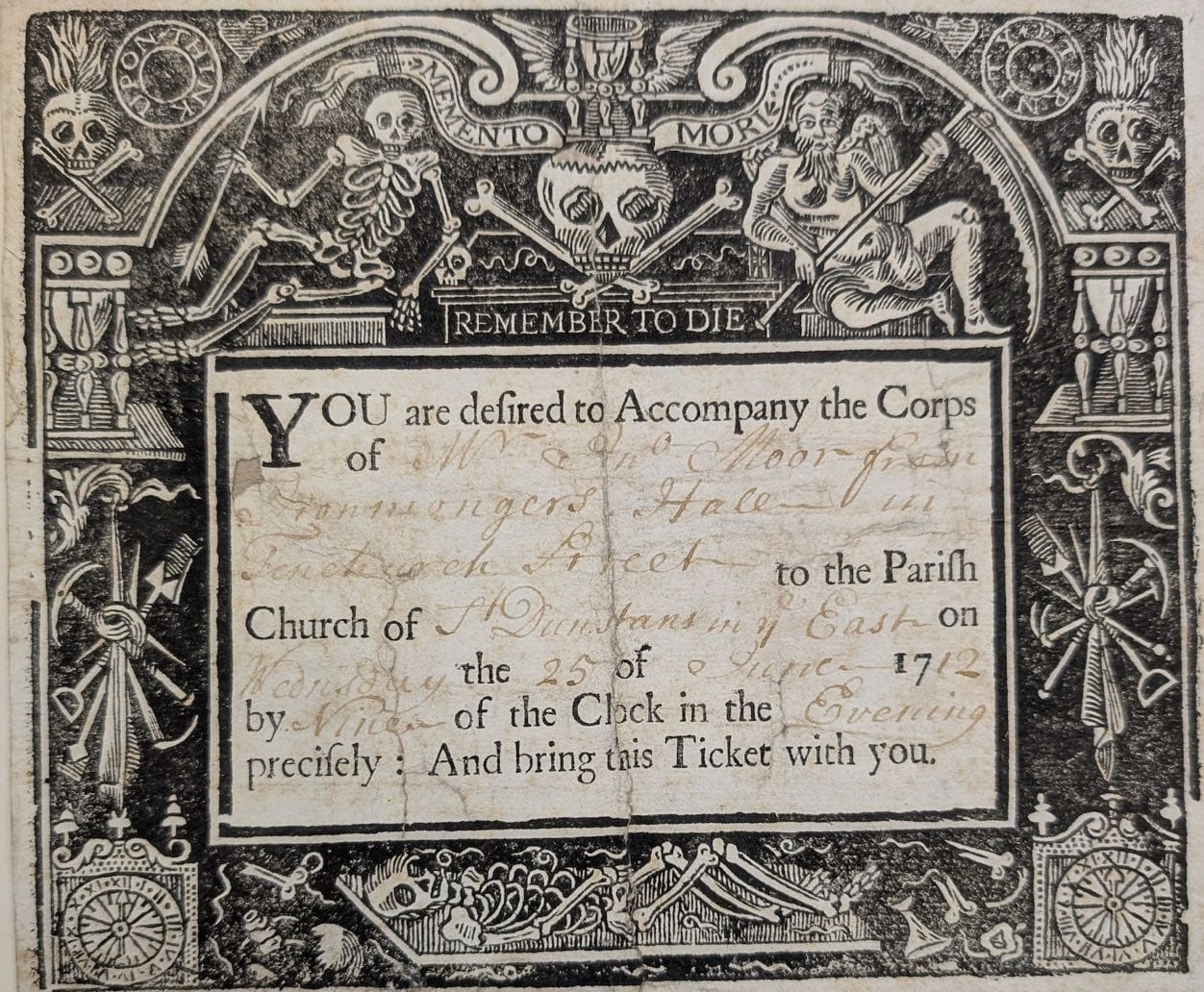
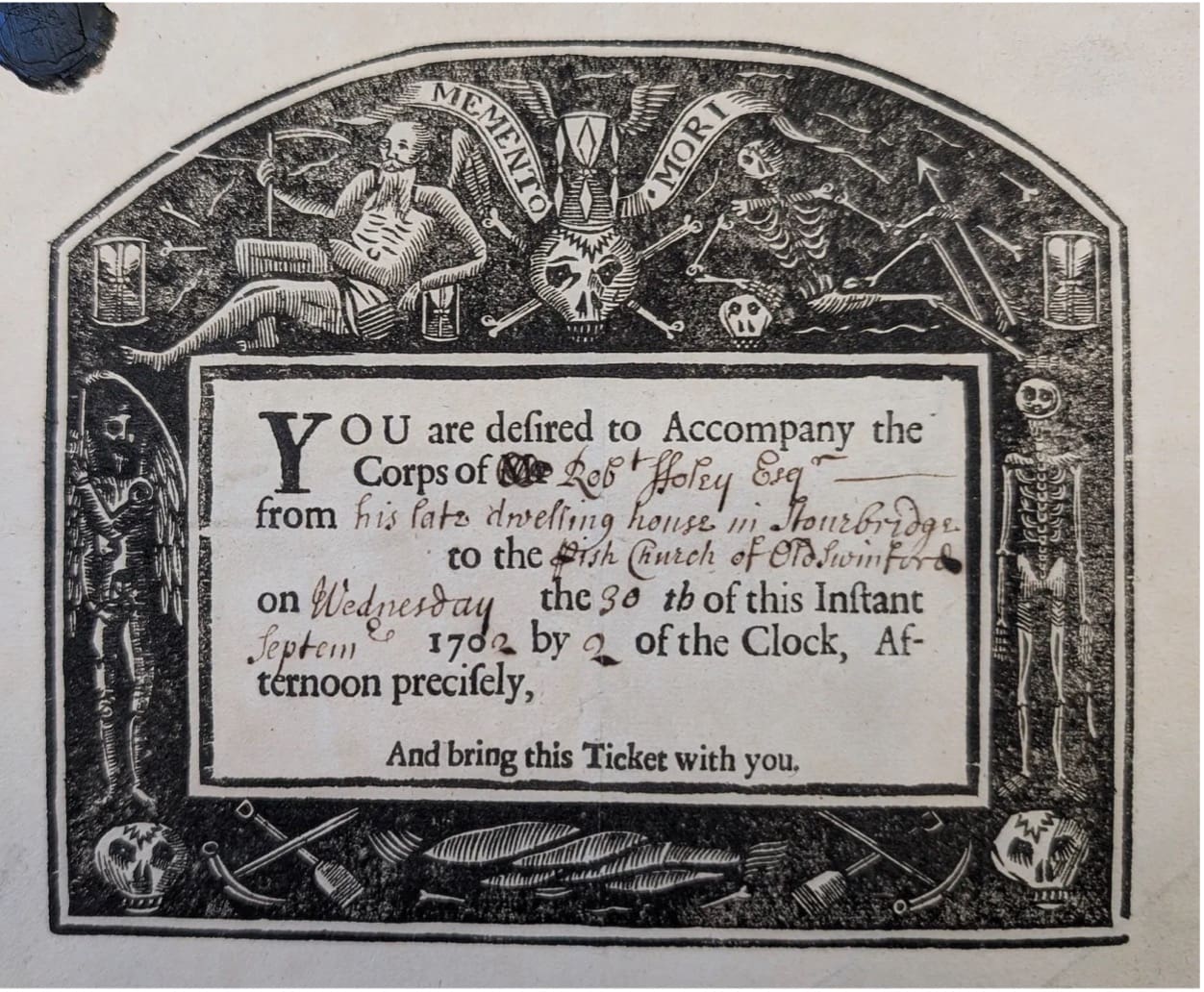
I can’t, sadly, link them to a particular stationer, but to go back to that idea of blanks – of print and manuscript together – funeral tickets are satisfyingly odd in that they can be either hybrid or all print. Here’s Maurice Rickards in the Encyclopedia of Ephemera:
Invitations appear in various formats, commonly with a blank centre panel for insertion of handwritten details or for overprinting in type.
The two from the Bodleian above are blanks, but the image at the top of this post is one from the British Museum where the details have been printed. Note how the symbols and their arrangement are almost identical in all three tickets.
Joseph Marshall, the London stationer who made the Burial in Woollen affidavits that were used in Upper Heyford, was happy to sell funeral tickets either as blanks or fully printed. (For example, he advertises: ‘Funeral Tickets printed at reasonable prices’.)
Perhaps the key factor is distance: if you live near enough to a printer, then the type can be set up quickly enough for the tickets to be sent out ahead of the funeral; if you don’t – you live in Upper Heyford, for example – you can have a supply of blanks ready in advance to be filled in by hand.